
Why Managing Expectations Will Be One of the Most Critical Business Skills Going Into 2026
As organizations look ahead to 2026, one thing is clear: complexity is no longer episodic it’s permanent.
Markets remain volatile. Operating models continue to shift. Teams are more distributed and matrixed than ever. Customers are better informed, more demanding, and far less patient. Internally, priorities change faster than alignment can keep up.
In this environment, many of the challenges leaders are trying to solve aren’t actually execution problems.
They’re expectation problems.
The Hidden Cost of Unmanaged Expectations
Missed deadlines. Dissatisfied customers. Burned-out teams. Escalations that feel “sudden” but were quietly building for weeks or months.
Across industries, we see the same pattern repeat itself: People believe expectations are clear until reality proves otherwise.
Assumptions go unspoken. Trade-offs are implied instead of discussed. Constraints are hinted at but never made explicit. And when circumstances change (as they inevitably do), teams hesitate to reset expectations because it feels uncomfortable, risky, or political.
The result is misalignment that compounds quietly until it becomes visible, expensive, and personal.
Why the Current AI Focus Isn’t the Silver Bullet
Many organizations are betting heavily on AI to solve these challenges faster delivery, better insights, fewer mistakes, more predictability.
AI absolutely helps.
But AI does not manage expectations.

It doesn’t negotiate trade-offs between stakeholders. It doesn’t surface hidden assumptions. It doesn’t push back on unrealistic commitments. It doesn’t repair trust when expectations are broken.
In fact, AI can unintentionally amplify expectation problems. Faster outputs often create the illusion that work should be faster, simpler, and cheaper even when complexity hasn’t actually gone away. When AI-driven speed isn’t paired with clear expectation-setting, disappointment increases rather than decreases.
AI changes how work is done. Expectation management determines whether that work is perceived as successful.
What’s Different About the 2026 Business Environment
Several trends are amplifying why expectation management is becoming a mission-critical skill:
- Faster decision cycles mean commitments are made with partial information
- Matrixed organizations create competing stakeholder expectations with no clear owner
- Client relationships are longer-term and more dynamic, not fixed engagements
- Change fatigue has reduced tolerance for surprises, even when they’re unavoidable
- AI and automation are raising expectations around speed while masking complexity

Technical expertise, tools, and automation are now table stakes. What increasingly separates high-performing teams is their ability to understand, set, manage, and recover expectations in real time.
Managing Expectations Is Not “Soft” — It’s a Delivery Skill
Managing expectations isn’t about being agreeable or optimistic. It’s about clarity, courage, and discipline.
It means:
- Surfacing hidden assumptions before they turn into conflict
- Negotiating realistic commitments instead of accepting implied ones
- Communicating limits, trade-offs, and boundaries clearly and early
- Establishing working agreements that can flex as conditions change
- Confidently pushing back or renegotiating when reality shifts
- Knowing how to recover trust when expectations are missed
These are not “nice-to-have” behaviors. They are delivery-critical skills for project teams, sales professionals, consultants, customer-facing roles, and leaders operating in complex environments.
Why Experience Alone Is No Longer Enough
Many organizations assume expectation management improves naturally with seniority. Sometimes it does but often it doesn’t.
Without a shared language, structured frameworks, and deliberate practice, people default to:
- Over-promising to avoid conflict
- Avoiding hard conversations
- Hoping alignment exists instead of verifying it
- Waiting too long to reset expectations
The organizations best positioned for 2026 aren’t relying on experience or tools alone. They are intentionally building human capability around expectation management — because no system, platform, or model can do this work for you.
Organizations that consistently manage expectations well don’t just avoid problems.
They:
- Build trust faster
- Navigate uncertainty more effectively
- Reduce friction between teams and stakeholder
- Recover more quickly when things go sideways
They don’t eliminate ambiguity they operate confidently within it, even as technology accelerates everything around them.
As the pace of change increases, the question isn’t whether expectations will shift. The question is whether your people have the skills to recognize misalignment early, address it directly, and realign before trust and delivery are compromised.
Want to Build This Capability in Your Organization?
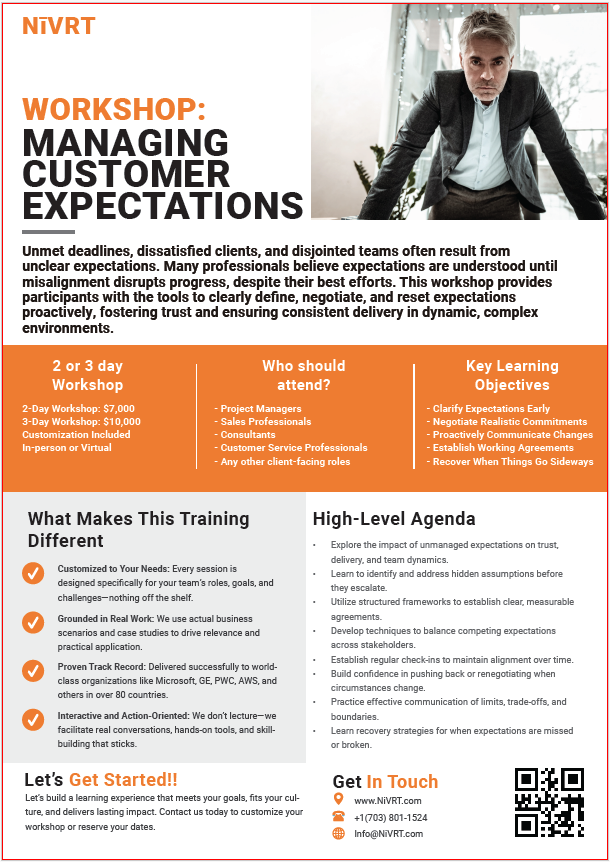
If this resonates, we’ve designed a Managing Expectations workshop to help teams build these skills in a practical, real-world way.
The program focuses on:
- Understanding where expectations actually break down
- Identifying and addressing hidden assumptions early
- Establishing clear, measurable agreements
- Balancing competing stakeholder expectations
- Confidently renegotiating when circumstances change
- Recovering trust when expectations are missed
It’s an interactive, action-oriented experience not a lecture and it’s customized to your team’s roles, challenges, and operating environment.
I’ve shared the flyer below with details on the workshop format, learning objectives, and delivery options. If managing expectations is a recurring challenge for your teams or your clients, this is a capability worth building intentionally as you head into 2026.
“We INTROSPECT to MODERNIZE, SCALE and OPTIMIZE your business with well-founded capabilities of Advisory. Orchestration. Intelligent Solutions that matter. and our offerings – Custom Solutions, Data & AI Empowerment and Customer Success – to enhance and transform your business. We augment these outcomes with well-rounded HR services, Training, Staffing, Recruiting solutions to bring you the success.”